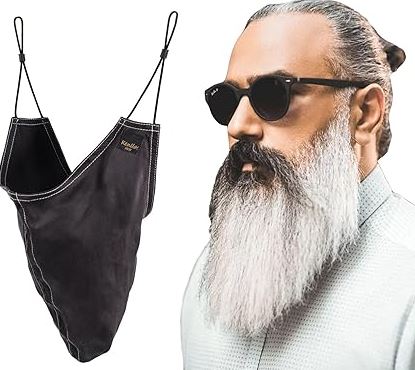
All products are selected by our Beard Stylish editors. If you buy something through our links as an Amazon Associate we earn from qualifying purchases.
If you wear a full beard on the job, standard beard snoods simply weren’t designed with you in mind. From food-service kitchens to pharmaceutical clean rooms, finding the right beard cover for a large beard is both a safety obligation and a daily frustration. This guide cuts through the noise — covering types, sizing, materials, compliance standards, and the practical tips that keep even the most substantial beards properly contained.
Why Beard Covers Matter in the Workplace
Beard covers — also called beard snoods, beard nets, or beard restraints — are mandated in a wide range of regulated environments. The FDA’s Food Code requires food handlers to use hair restraints that effectively cover facial hair, while ISO-classified clean rooms, healthcare settings, and manufacturing facilities maintain similar requirements. The core purpose is contamination control: loose facial hair can carry pathogens, particulates, and other contaminants that compromise product integrity and public safety.
For people with full or long beards, compliance is not simply a matter of pulling on a generic net. A cover that fits poorly offers no real protection — and can actually create a false sense of security. That’s why understanding the right product for your beard length and density is essential.
What Counts as a “Large Beard” for Sizing Purposes?
Most beard cover manufacturers categorise beards by length measured from the chin. Generally speaking:
Quick reference — beard size categories
- Short beard: under 1 inch / 2.5 cm
- Medium beard: 1–3 inches / 2.5–7.5 cm
- Large / full beard: 3–6 inches / 7.5–15 cm
- Extra-large / long beard: 6 inches+ / 15+ cm
If your beard falls into the large or extra-large category, you’ll need a cover specifically designed for increased volume and length — not simply a larger version of a standard snood.
Types of Beard Covers for Large Beards
There is no single best beard cover for large beards. The right choice depends on your industry, the level of contamination control required, how long you wear it, and personal comfort. Here are the main types to consider.
?
Extended Beard Snoods
Deeper pouch design to accommodate volume; the most common option for food service with full beards.
?
Balaclava-Style Covers
Full-face fabric covering leaving only eyes and nose exposed. Preferred in pharmaceutical and clean room environments.
?
Neck & Beard Wraps
Fabric wraps that secure under the chin and around the neck. Better for very long or wide beards that defeat pouch designs.
?
Full Hood Covers
Used in high-classification clean rooms. Covers head and beard as a single unit, ensuring maximum containment.
Materials: What Your Beard Cover Should Be Made From
Material choice directly affects breathability, durability, filtration level, and skin comfort — especially during long shifts. The most common materials for large beard covers include:
| Material | Best for | Key benefit | Limitation |
|---|---|---|---|
| Polypropylene non-woven | Food service, general manufacturing | Low cost, lightweight | Single-use; low breathability |
| Spunbond polyester | Pharmaceutical, clean rooms | Higher particulate filtration | Less comfortable over long shifts |
| Cotton/poly blends | Healthcare, food production | Comfortable, reusable | Requires laundering protocols |
| Microfibre | Clean rooms, electronics | Very low lint shed | Higher cost |
Disposable vs. Reusable Beard Covers
Disposable beard covers offer simplicity and guaranteed hygiene between uses — important in high-risk food or medical environments. Reusable options reduce ongoing costs and environmental impact, but require a validated laundering process. For large beards, reusable covers are often more comfortable and provide a better fit over time as the material conforms to your beard’s shape.
⚠️
Compliance note
Reusable covers must meet the same contamination-control standards as disposables. Always verify that laundering procedures align with your facility’s hygiene protocols and applicable regulations (FDA, HACCP, ISO, etc.).
How to Choose the Right Beard Cover for a Large Beard
Step-by-step selection guide
- Measure your beard length from the chin, and its widest point across the jaw.
- Identify your compliance standard (FDA Food Code, ISO class, OSHA, facility SOP).
- Select cover type based on required containment level (snood, balaclava, full hood).
- Choose material based on shift length, skin sensitivity, and particulate requirements.
- Test the fit — all beard hair must sit inside the cover with the elastic or tie secure against skin, not hair.
- Check for gaps at the jawline and chin — common failure points with large beards.
Proper Fit: The Most Common Mistake with Large Beard Covers
A beard cover that is “on” but not properly fitted is a compliance violation waiting to happen. With large beards, the most frequent fitting errors are elastic bands resting on the beard rather than the skin, insufficient pouch depth leaving the chin beard exposed, and covers that gap at the sides when the wearer turns their head.
When fitting your cover, place the elastic or band against bare skin at the cheeks and under the jaw — all facial hair should be gathered entirely inside the pouch. If you cannot achieve this with a standard-size product, move to the next size up or switch to a wrap-style cover designed for greater beard volume.
Beard Covers by Industry: What the Regulations Actually Require
Understanding the specific standard that governs your workplace prevents both non-compliance and unnecessary over-specification. Here is a brief overview of common regulatory contexts.
Food service and food manufacturing fall under FDA Food Code Section 2-402.11, which mandates effective hair restraints covering facial hair. The operative word is “effective” — regulators look for full containment, not simply the presence of a cover.
Pharmaceutical manufacturing is governed by FDA cGMP regulations (21 CFR Part 211) and, where applicable, EU GMP guidelines. These environments typically require full balaclava-style or hood covers to prevent any potential contamination of sterile products.
Healthcare settings — particularly surgical theatres — follow guidance from the Association of periOperative Registered Nurses (AORN), which recommends that all facial hair be covered at all times in the restricted zone.
Clean room environments classified under ISO 14644 require beard covers appropriate to the class — with ISO Class 5 and above generally mandating full hoods.
✅
Expert tip
Always consult your facility’s written hygiene policy alongside the relevant regulatory standard. Internal SOPs are often more stringent than the baseline regulations and represent the legally enforceable standard within your workplace.
Tips for Wearing Beard Covers Comfortably on Long Shifts
Comfort matters for compliance: workers who find beard covers uncomfortable are more likely to wear them incorrectly or remove them. For large beards, consider braiding or loosely bundling the beard before applying the cover — this reduces bulk and minimises pulling. Look for covers with wide, soft elastic rather than thin bands, which can irritate the skin across an eight-hour shift. If skin irritation is a recurring problem, latex-free and hypoallergenic materials are widely available.
Some workers with particularly wide or dense beards find that a light application of unscented beard balm (used only in non-food environments where cosmetics are permitted) helps the beard sit more compactly inside the cover.
Frequently Asked Questions
What is the best beard cover for a very long beard?
For beards over 6 inches, a balaclava-style cover or a dedicated large-volume beard wrap offers the most reliable containment. Standard snoods do not have sufficient pouch depth for very long beards and frequently leave the chin hair exposed.
Are beard covers required by law?
In regulated industries — including food service, pharmaceutical manufacturing, healthcare, and many clean room environments — beard covers are required by federal regulation (FDA, OSHA) or industry standards (ISO, AORN). In other workplaces they may be mandated by internal hygiene policy. Always check the requirements specific to your industry and facility.
Can I use a regular beard net if I have a large beard?
A regular beard net is unlikely to provide effective containment for a large beard. Standard snoods are designed for beards under 3 inches. Using an undersized cover leaves hair exposed at the chin and cheeks, which constitutes a compliance failure in regulated environments and undermines the purpose of wearing a cover at all.
How do I keep a beard cover from slipping off a large beard?
Ensure the elastic band sits against skin, not on top of beard hair. For very large or wide beards, use covers with adjustable ties or two-point elastic systems. Some workers use a light-hold unscented hairband at the base of the beard to gather it before applying the cover, which reduces slippage in environments where this is permitted.
What materials are best for sensitive skin?
Look for latex-free, hypoallergenic non-woven polypropylene or soft cotton-blend covers. Microfibre options are also gentle against skin. Avoid covers with dyed elastic bands if you are prone to contact dermatitis.
How often should disposable beard covers be changed?
Disposable beard covers should be replaced each time you re-enter a controlled area, after any break, or whenever the cover becomes visibly soiled, wet, or damaged. Do not reuse single-use covers — doing so defeats their contamination-control function and may violate facility protocols.
Whether you work in food service, a pharmaceutical plant, or a clean room, the right beard cover for a large beard is one that fully contains all facial hair, meets your industry’s regulatory requirements, and is comfortable enough to wear correctly throughout your entire shift. Fit and compliance go hand in hand — a cover that doesn’t stay in place protects no one.
- ●【 FOUR FABRIC OPTIONS 】 Multiple high-end materials are deployed, including 3 kinds of careful selected 100% mulberry (19-23 momme),and one non-silk waterproof high-end fabric used by luxury brand. Cover your most subtle needs in different circumstances.
- ●【 SILKY & LIGHT 】 100% Mulberry silk, most expensive fabric, provide you unmatchable wearing experience. It is 100% natural, soft and silky, the best fabric caring for your skin and your loved beard. It lets your beard to breath easily, and grow better. It is also super light. You can’t feel it when you sleep.
- ●【 THREE-DIMENSIONAL MANUAL DESIGN 】 Unique Large three-dimensional /stereo cutting designed by our Kenllas design team. Large enough to cover your beard in a comfort way. Adjustable ear loops provided to care for different size/shape of beard. Special soft straps are also employed. All details of our bandana are 100% hand made to guarantee the best quality.