
All products are selected by our Beard Stylish editors. If you buy something through our links as an Amazon Associate we earn from qualifying purchases.
Whether you’re sculpting a sharp goatee, maintaining a full beard, or trimming stray hairs between barbershop visits, the right scissors make all the difference. Unlike standard household scissors or hair-cutting shears, beard scissors are specifically engineered for the texture, density, and growth patterns of facial hair. Choosing the best scissors for beards means understanding blade type, handle design, steel quality, and how those features map to your specific grooming goals.
This guide walks you through everything you need to know to make a confident, informed purchase.
Why Beard Scissors Are Different From Regular Scissors
Facial hair is coarser, curlier, and denser than scalp hair, which means it places greater stress on blades. Using standard scissors on your beard leads to uneven cuts, split ends, and premature blade dulling.
Professional beard scissors and grooming shears are designed with:
- Shorter blades (typically 4–6.5 inches total length) for close-up control
- Micro-serrated edges on at least one blade to grip coarse beard hairs
- Ergonomic offset or crane handles that reduce wrist strain during detailed work
- High-carbon or Japanese stainless steel for edge retention and corrosion resistance
Understanding these design elements is step one toward choosing a pair that truly performs.
Key Features to Look for in Beard Grooming Scissors
1. Blade Length and Style
For most beard styles, a blade length of 4.5 to 5.5 inches (total scissor length) offers the best balance of precision and control. Longer blades suit those trimming large, full beards across wide sections. Shorter blades are ideal for detailing mustaches, necklines, and sculpting defined edges.
Look for a convex blade edge if you want a razor-sharp, clean-cut finish. Beveled edges are more durable and easier to sharpen at home but deliver a slightly less refined cut.
2. Steel Quality
The material of the blade determines longevity, sharpness, and rust resistance. The most common and respected options are:
- Japanese stainless steel (e.g., Hitachi AUS-8 or VG-10): Preferred by professional barbers for its balance of hardness and flexibility. Holds a fine edge longer than most alternatives.
- German stainless steel: Slightly softer than Japanese variants, which makes it easier to sharpen but requires more frequent maintenance.
- High-carbon steel: Extremely sharp and durable, though more prone to rust if not properly dried and oiled after use.
If longevity and sharpness retention are your priorities, Japanese stainless steel scissors are generally the professional standard.
3. Handle Ergonomics
The handle design affects comfort, especially during longer grooming sessions. There are three main configurations:
- Straight handle: Traditional and symmetrical, suitable for standard grooming grips
- Offset handle: Lowers the thumb ring for a more natural hand position, reducing repetitive strain
- Crane handle: The most ergonomic option, with a dramatically lowered thumb loop that promotes a neutral wrist posture
For men who groom daily or maintain intricate beard styles, an offset or crane handle significantly reduces fatigue.
4. Tension System
A quality tension screw allows you to adjust how easily the blades open and close. Look for a flat-head or key-adjustable tension screw, which lets you customize resistance to your personal cutting style. Blades that are too loose will fold hair rather than cut it; too tight and you’ll fatigue your hand quickly.
Types of Beard Scissors and Their Best Uses
| Scissor Type | Best For |
|---|---|
| Straight grooming scissors | General beard trimming and length maintenance |
| Thinning shears | Removing bulk without reducing visible length |
| Curved scissors | Shaping mustaches and following facial contours |
| Detailing/micro scissors | Precision work around lips, nose, and neckline |
Many experienced groomers keep two pairs: a straight trimming scissor for length and a thinning shear for texture and volume control.
How to Use Beard Scissors Correctly
Even the best beard trimming scissors underperform in untrained hands. Follow this method for consistent, professional-looking results:
- Wash and dry your beard completely. Wet hair appears longer, which leads to over-cutting. Always trim dry for accurate results.
- Comb through thoroughly. Use a wide-tooth beard comb to detangle and lift hairs to their natural position.
- Work in sections. Divide your beard into zones — cheeks, chin, mustache, neckline — and address each individually.
- Cut parallel to the comb. Run the comb upward through the beard and snip the hair protruding above the comb teeth. This point-cutting technique creates a natural, textured finish.
- Check symmetry frequently. Step back from the mirror regularly to assess balance before removing more length.
- Finish with beard oil. After trimming, apply a few drops of beard oil to condition the hair and soothe the skin beneath.
Maintaining Your Beard Scissors for Long-Term Performance
Even premium facial hair scissors degrade quickly without proper care. Extend the life of your shears with these habits:
- Wipe blades clean after each use with a soft, dry cloth
- Apply one drop of scissor oil to the pivot point weekly
- Store in a protective pouch or case to prevent nicks and blade damage
- Sharpen professionally every 6–12 months depending on use frequency
- Never use beard scissors on anything else — cutting tape, paper, or clothing dulls the blade immediately
Frequently Asked Questions
What size scissors are best for beard trimming? For most men, scissors with a total length of 4.5 to 5.5 inches offer the ideal combination of control and efficiency. Shorter scissors excel at detailing, while slightly longer ones suit full, thick beards.
Are thinning shears good for beards? Yes. Thinning shears — also called texturizing scissors — are excellent for removing bulk from dense beards without noticeably reducing length. They’re especially useful for men with coarse or curly facial hair prone to a “puffed out” appearance.
How often should I trim my beard with scissors? Most men benefit from a light trim every 1–2 weeks to manage stray hairs and maintain shape, with a more thorough scissor trim every 3–4 weeks.
Can I use hair scissors for my beard? Technically yes, but it’s not recommended. Hair-cutting scissors are calibrated for finer scalp hair. Using them on coarse beard hair dulls the blades faster and can result in uneven cuts. Dedicated beard scissors deliver cleaner, more controlled results.
What’s the difference between beard scissors and beard shears? The terms are often used interchangeably. “Shears” typically refers to scissors longer than 6 inches, though in grooming contexts, both words describe the same category of facial hair trimming tools.
Do I need to oil my beard scissors? Yes. A single drop of blade oil applied to the pivot point after each use prevents corrosion and keeps the tension smooth. Neglecting this shortens the useful life of even high-quality scissors significantly.
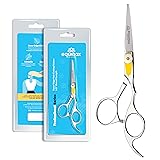
- Design Excellence. Crafted from the finest Japanese stainless steel, Equinox Hair Scissors feature precisely tempered blades and hand-sharpened razor-cutting edges for the perfect snip.
- Ergonomic Comfort. Designed with a curved finger rest and comfortable finger holes, our professional hair cutting scissors are a dream for hair salon workers, barbers, and home stylists alike.
- Versatile Precision. Measuring 6.5 inches in overall length with 2.55-inch blades, our hair shears are designed for safety and ease of use on everyone–men, women, elderly, kids, and even babies.