All products are selected by our Beard Stylish editors. If you buy something through our links as an Amazon Associate we earn from qualifying purchases.
False beards have evolved far beyond Halloween costume shops. Whether you’re a professional actor preparing for a period drama, a cosplayer building an intricate character, a theatrical makeup artist working on a film set, or simply someone who wants a convincing beard for a special event, the market now offers options that range from budget-friendly costume pieces to hyper-realistic prosthetic-grade facial hair. This guide covers everything you need to know before buying.
What Are False Beards?
False beards — also called fake beards, artificial beards, costume beards, or theatrical beard pieces — are wearable facial hair accessories designed to simulate a real beard. They are constructed from a variety of materials including synthetic fiber, human hair, yak hair, and theatrical lace, and are attached using spirit gum, prosthetic adhesive, or elastic bands.
The quality, realism, and intended use case vary dramatically between product types, making it critical to understand the differences before purchasing.
Types of False Beards Available
1. Elastic Band Costume Beards
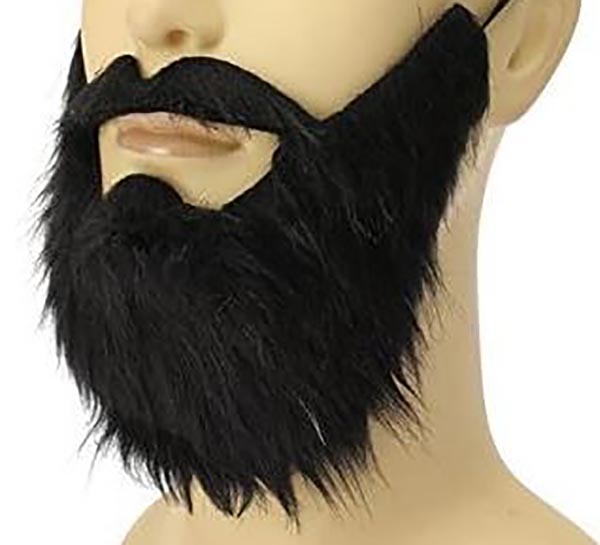
The most affordable and widely available type. These snap around the ears with a thin elastic loop and are typically made from acrylic fiber or polyester. They suit children’s costumes, one-time-use events, or humorous applications. Realism is low, but convenience is high.
Best for: Halloween costumes, novelty dress-ups, children’s fancy dress
2. Spirit Gum Adhesive Beards
A step up from elastic styles. These are flat-backed pieces applied directly to the skin using spirit gum or skin-safe theatrical adhesive. The bond is stronger, the look more realistic, and they sit flush against the face for a more convincing silhouette.
Best for: Stage theatre, amateur film production, cosplay events
3. Lace Front Fake Beards
The professional standard. Lace front beards are constructed on a fine mesh base — typically Swiss lace or HD lace — onto which individual hairs are hand-knotted or ventilated. When properly applied and blended, lace beards are virtually undetectable on camera and in close-up performance.
Best for: Film, television, professional theatre, high-resolution photography
4. Full Prosthetic Beard Pieces
Used in professional film and special effects makeup. These are silicone or foam latex prosthetic appliances with punched-in real or synthetic hair. They require professional application but produce the highest level of realism, including a natural skin-to-hair transition.
Best for: Film production, high-budget theatre, special effects makeup artists
5. Partial Beard Pieces and Goatees
Not all false beard purchases are full-face. Many buyers look specifically for goatees, chin patches, mutton chops, or sideburn pieces to supplement existing facial hair or build a specific character look. These partial pieces offer flexibility and are widely available in both adhesive and lace formats.
Key Materials Explained
Synthetic Fiber: Inexpensive, consistent color, not heat-styleable. Best for single-use or budget applications.
Human Hair: Natural look and texture, can be styled with heat, most realistic color variation. Higher price point.
Yak Hair: A common theatrical alternative to human hair. Coarser texture, excellent for period-accurate styling (Viking, Victorian, Old West looks). Takes color well.
Kanekalon Fiber: A premium synthetic that mimics human hair more closely than standard acrylic. Often used in mid-range lace beard products.
How to Choose the Right False Beard
Define your use case first. A beard for a school play requires an entirely different product than a beard for a professional film role. Buying a $12 elastic beard for a film shoot will show on camera. Buying a $200 lace piece for a single Halloween party is unnecessary spend.
Match hair color precisely. Measure the undertone of the beard against the actor’s or wearer’s natural coloring. Many reputable suppliers offer color swatches or gradient options for grays.
Consider skin tone and adhesive sensitivity. Lace front beards require adhesive contact with skin for hours at a time. If the wearer has sensitive skin, look for latex-free prosthetic adhesives and test patch before full application.
Check the knotting density. For lace beards, the number of hairs per square centimeter determines how natural the hairline looks. Higher density at the mustache and lower density at the outer edges mimics natural beard growth patterns.
Account for length and style. A Santa Claus beard has entirely different construction requirements than a short stubble piece. Length affects weight, adhesion demands, and movement on camera.
Applying and Removing False Beards Safely
Application:
- Clean and dry the skin thoroughly — no moisturizer or oil
- Apply a thin layer of spirit gum or prosthetic adhesive to the lace or backing
- Allow the adhesive to become tacky (30–60 seconds)
- Press firmly and hold for at least 30 seconds
- Blend edges with skin-tone makeup or setting powder
Removal: Never pull. Use an oil-based adhesive remover (Isopropyl Myristate or dedicated spirit gum remover) to dissolve the bond before gently lifting edges. Pulling damages both the skin and the lace.
Where to Buy False Beards
Theatrical supply stores carry professional-grade lace beards and prosthetic pieces. Look for suppliers specializing in stage and film makeup.
Online costume retailers stock the full range from budget elastic styles to mid-range adhesive beards. Read customer reviews specifically about adhesive quality and color accuracy.
Specialist wig and hair suppliers often carry the highest-quality ventilated lace pieces, particularly for professional applications.
Custom makers on artisan marketplaces can produce bespoke beard pieces matched precisely to photos, offering unmatched realism for high-stakes productions.
Frequently Asked Questions
How long does a false beard stay on? Spirit gum adhesive beards typically hold 4–8 hours under normal conditions. Prosthetic adhesives (such as Telesis or Pros-Aide) can hold 12–16 hours or longer with proper skin prep and sealants.
Can false beards be reused? Lace and high-quality adhesive beards can be reused multiple times if handled carefully during removal and stored flat on a block or form. Elastic costume beards are generally single-use.
Do false beards look real in photos? Lace front beards with human or quality synthetic hair photograph convincingly at most distances. Standard elastic costume beards will not pass close-up photography. For professional shoots, always use lace construction.
Are false beards safe for sensitive skin? Most theatrical adhesives are skin-safe, but individuals with latex allergies must specifically seek latex-free products. Always patch test any adhesive 24 hours before full application.
How do I clean a false beard? Use a gentle shampoo diluted in cool water. Submerge the piece briefly, swirl gently, rinse, and lay flat on a towel to dry. Never wring or brush when wet.
What is the difference between a lace beard and a regular fake beard? A lace beard is built on a transparent mesh base that creates an invisible hairline against skin, making it appear as though hair is growing directly from the face. Regular fake beards have a visible solid backing that is detectable at close range.
Can I dye or style a false beard? Human hair and yak hair beards can be dyed and heat-styled similarly to natural hair. Synthetic beards generally cannot withstand heat styling and have limited dyeability unless specifically labeled heat-resistant.
No products found.